
corporate-group-booking-increase-ado-1

Scale Your Airline Corporate Booking Revenue by 25% with Automation

Introduction

In the fast-paced world of airlines, maximizing corporate booking revenue is a top priority. Airlines are challenged by fluctuations in operational costs, competitive markets, and shifting corporate travel demands. Traditional methods no longer meet these dynamic needs. That’s where the Corporate Revenue Maximizer comes into play, a revolutionary technology designed to scale your corporate booking revenue by up to 25%.

In this blog, we’ll explore how this game-changing technology can transform your corporate sales strategy, its key features, and why it’s a must-have for modern airlines.

Table of Contents

The Corporate Travel Challenges

Corporate travel represents a significant revenue stream for airlines, but managing it effectively is complex. Common challenges include:

  • Rising Operational Costs: Fuel prices, labor costs, and infrastructure expenses are constantly increasing.
  • Limited Visibility: Difficulty in tracking corporate spending patterns and understanding client preferences.
  • Inefficient Processes: Manual workflows and old systems that slow down sales.
  • Lack of Personalization: Generic offers that do not meet the needs of different corporate clients.

Solving these problems requires more than just traditional tactics; it calls for a data-driven, automated approach.

Corporate Revenue Maximizer

The Corporate Revenue Maximizer is part of the Airline Distribution Optimizer platform. This innovative tool helps airlines:

  • Increase Revenue: By optimizing corporate deals and creating targeted offers.
  • Improve Efficiency: Through automation of manual processes, reducing administrative workload.
  • Enhance Customer Relationships: With personalized offers tailored to corporate clients’ specific needs.

Key Features of the Corporate Revenue Maximizer

1. Harnessing Real-Time Data Insights

The Corporate Revenue Maximizer taps into real-time booking data (PNR data), giving airlines instant visibility into corporate travel behaviors. This allows for:

  • Accurate Performance Tracking: Track which corporate deals are performing well.
  • Informed Decision-Making: Identify trends and make data-driven strategic decisions.
  • Agility: Quickly adapt to changing market conditions and client needs.

2. Using AI to Personalize Offers

The heart of the Corporate Revenue Maximizer is artificial intelligence (AI), which analyzes booking patterns, travel frequencies, and client preferences in order to:

  • Create Tailored Offers: Deliver dynamic deals that resonate with each corporate client.
  • Predictive Analytics: Be better prepared than clients to fulfill future booking requests.
  • Automated Customization: Modify offers dynamically in real time, as the data evolves.

3. Selling Faster with Automation

Manual handling leads to slowed sales and increases the possibility of mistakes. Corporate Revenue Maximizer streamlines sales with automation:

  • Offer Management: Auto-generates, sends, and tracks corporate offers automatically.
  • Contract Handling: Simplifies paper handling, minimizing administrative burdens.
  • Seamless Integration: Works seamlessly with current airline systems to maintain the ease of workflow.

4. Dynamic Pricing and Discount Strategies

Dynamic pricing is a crucial aspect of modern competition. It allows airlines to:

  • Optimize Fare Strategies: Price according to demand, booking windows, and corporate client behavior.
  • Flexible Discounting: Apply variable discounts depending on the particular corporate account.
  • Revenue Maximization: Ensure profit while remaining competitive.

How It Drives Up to 25% Revenue Growth?

The Corporate Revenue Maximizer drives revenue growth by:

  • Increased Corporate Bookings: Personalized deals attract more corporate travelers.
  • Higher Conversion Rate: Targeted offers lead to higher acceptance levels.
  • Operational Efficiency: Automatic reductions in operational costs improve margins overall.
  • Data-Driven Decision-Making: Insights from analytics will lead the way to the most intelligent revenue-generating decisions.

Get a Personalized Consultation from Us

Real-world Impact: Case Studies

Case Study 1: International Airline Increases Revenue by 22%, using the Corporate Revenue Maximizer, a major international airline saw a 22% increase in corporate bookings in six months. Real-time data analysis and dynamic pricing helped in this process.

Case Study 2: Regional Carrier Reduces Admin Costs by 30%. A regional airline integrated the tool into its sales workflow, automating offer management and contract processing. This led to a 30% reduction in administrative costs, directly impacting profitability.

Why Airlines Need the Corporate Revenue Maximizer

The airline industry is changing at breakneck speeds. Corporate customers demand:

  • Response Times: Speedy, customized offers.
  • Tailored Experiences: Deals tailored to their precise travel requirements.
  • Data Transparency: Real-time reporting and insights.

Without the right technology, airlines risk falling behind competitors who can deliver these expectations seamlessly.

Conclusion

In today’s competitive airline industry, scaling corporate booking revenue requires more than traditional sales tactics. The Corporate Revenue Maximizer, part of the Airline Distribution Optimizer, is the game-changing technology airlines need to unlock new revenue streams, enhance efficiency, and build lasting corporate relationships.

Ready to scale your corporate booking revenue by up to 25%? Discover how the Corporate Revenue Maximizer can transform your airline’s growth strategy today.

Corporate Suitcase

Maximizing Corporate Airline Revenue: Key Challenges & Innovative Solution

Introduction

The airline industry is a dynamic competitive landscape where profit depends on optimization of every possible revenue stream. Among these revenue streams, corporate travel is particularly important as a significant contributor to airline revenues. However, due to the increasing dynamism in business travel combined with emerging market trends and disruptions caused by technological advancements, maximizing corporate revenue is becoming increasingly challenging for airlines.

Traditional methods of corporate travel management in the form of long-term contracts and reliance on travel agencies can no longer address the needs of modern businesses. Airlines face such challenges as unpredictable corporate demand, high operational costs, and lack of personalization in offers made to corporate clients. These result in not just revenue loss but also affect the satisfaction of the customers and operational efficiency.

In this blog, we’ll get into the details of corporate travel management issues, examine the effects of such issues on airlines, and bring forth a groundbreaking solution, the Corporate Revenue Maximizer by Airline Distribution Network. This next-generation tool will disrupt the current dynamics of managing airline corporate accounts in real-time by providing actual time data insights, AI-driven personal offers, and automation for driving growth and profitability.

Inefficiencies in Corporate Travel Management

Corporate travel is a vital source of revenue for airlines, but the industry is plagued by several persistent issues that prevent its full revenue potential from being tapped. One such major issue is the inability to predict corporate market trends effectively. Airlines cannot accurately track corporate performance, which means that it becomes impossible to measure success and, consequently, incentivize both corporate clients and account managers.

Additionally, higher operational costs burden airlines, as they continue to rely heavily on corporate sales teams for sourcing, contracting, and tracking corporate sales performance. The increasing corporate incentives without a proportional rise in sales further exacerbates this problem. Airlines also face challenges in influencing future travel decisions, often depending on long-term contracts and travel agents, limiting their ability to engage corporates directly and dynamically.

Communication inefficiencies with corporate entities and travelers, coupled with the inability to create personalized offers and track real-time corporate spending, are sources of inefficiency. For corporate clients, a lack of real-time connection to airlines leads to higher ticket costs, non-personalized offers, and a poor travel experience.

Impact on the Airline Business

All these challenges significantly impact the airline industry. It makes it difficult for airlines to derive insights about their corporate sales performance, leading to missed revenue opportunities. The airline industry maintains huge sales teams and incurs heavy costs on their maintenance, but inefficient processes lengthen contract negotiation periods, decrease productivity, and increase frustration levels among clients.

Furthermore, the impersonal approach in corporate travel products reduces customer satisfaction in terms of loyalty and repeat business. The reliance on old-style travel agents and legacy technology means that airlines are not optimized to take advantage of data-driven initiatives to streamline corporate sales and marketing.

Corporate Revenue Maximizer by Airline Distribution Optimizer

In this regard, we have developed Corporate Revenue Maximizer by Airline Distribution Optimizer, an innovative product solution. This solution helps transform corporate travel management through real-time data analysis and AI-driven insights, addressing the associated challenges.

Our product reads real-time PNR data, monitoring corporate deal usage and offering airlines actionable insights for maximizing revenue opportunities. Leveraging AI technology, it creates tailored offers in real time based on booking behaviors and corporate preferences. It also utilizes historical booking patterns to effectively target corporate customers and maximize engagement and conversion rates.

Key Features of the Corporate Revenue Maximizer

Real-time Data Analysis: Obtain instant insight into corporate travel trends and performance.

AI-based Personalized Offers: Develop real-time, tailored offers based on corporate loyalty and employee profiles.

Automated Offer Filing: Automate the process of creating and approving offers to minimize human effort.

Flexible Sales Process: Facilitate direct corporate bookings or integration with travel agencies to offer maximum flexibility.

Performance and Growth Insights: Identify underperforming segments and growth opportunities with deep analytics.

Why Corporate Revenue Maximizer by Airline Distribution Optimizer ?

Corporate Revenue Maximizer by Airline Distribution Optimizer is more than a revenue management tool. It is a comprehensive platform designed to empower airlines with:

Seamless Integration: Easily connects with existing revenue management and reservation systems.

Scalability: Adaptable to the needs of airlines of all sizes, from regional carriers to global giants.

User-Friendly Interface: Simplifies complex data insights into actionable strategies for sales and marketing teams.

Continuous Support: Backed by Airline Distribution Optimizer’s expert support team to ensure smooth implementation and ongoing optimization.

Get a Personalized Consultation from Us

Benefits of Using the Corporate Revenue Maximizer

Implementing the Corporate Revenue Maximizer offers numerous benefits:

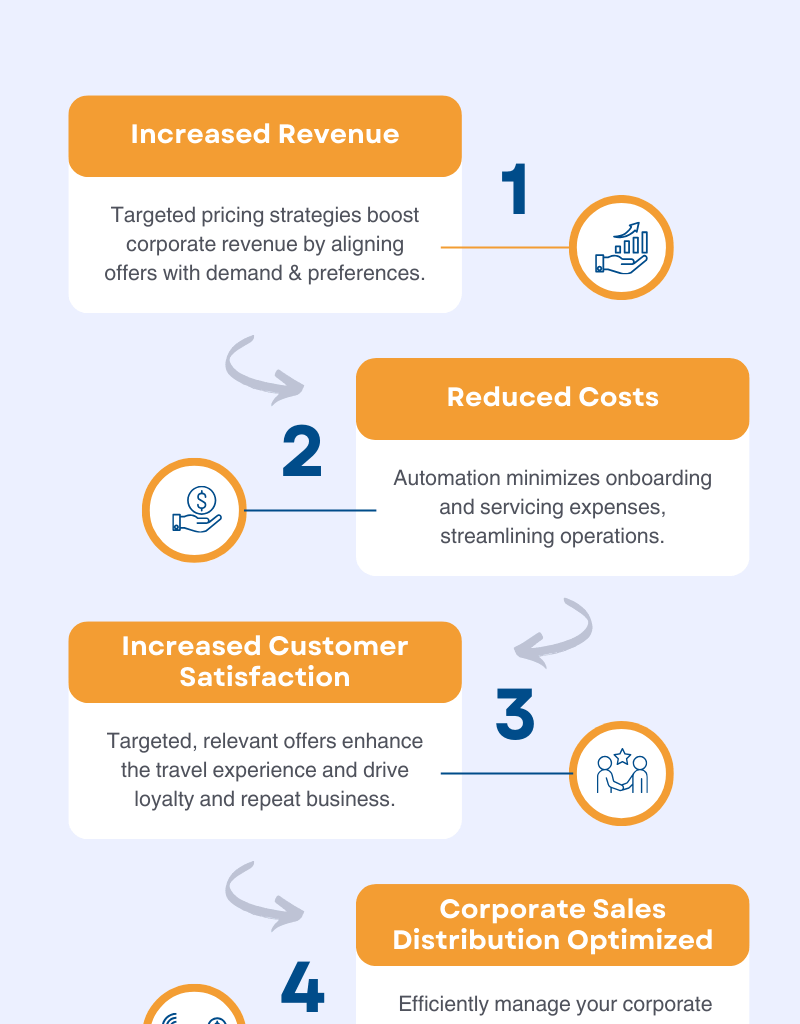
Increased Revenue: Target pricing strategies boost corporate passenger revenue by aligning offers with demand and preferences.

Reduced Costs: Automation minimizes onboarding and servicing expenses, streamlining operations.

Increased Customer Satisfaction: Targeted, relevant offers enhance the travel experience and drive loyalty and repeat business.

Corporate Sales Distribution Optimized: Efficiently manage your corporate sales channels to maximize reach and profitability.

Data-Driven Decision Making: Empower your sales and marketing teams with real-time insights and performance metrics.

benefits of using corporate revenue maximizer

Conclusion

The airline industry is at a crossroads. The old way of managing corporate travel is no longer sufficient. Corporate Revenue Maximizer by Airline Distribution Optimizer provides a complete solution to the challenges airlines face in optimizing revenue, reducing costs, and increasing customer satisfaction through data-driven strategies and AI-powered tools.

Take your corporate travel management into the future and discover new revenue opportunities with the Corporate Revenue Maximizer feature powered by Airline Distribution Optimizer.

Corporate Satisfaction

Transforming Corporate Customer Satisfaction in Airlines

Importance of Corporate Customer Satisfaction for Airlines 

Corporate customer service in airlines encompasses a range of interactions, from corporate booking processes to post-trip expense management. Effective corporate customer service ensures business clients feel valued and their unique needs are met at every touchpoint. A modern B2B corporate portal for airline operations plays a critical role in delivering this consistency by centralizing policy controls, booking visibility, spend tracking, and reporting capabilities across corporate accounts. This comprehensive approach helps mitigate issues swiftly, provide seamless travel experiences for employees, and resolve corporate travel inquiries efficiently.

5 Key Pillars of Corporate Customer Service

How does corporate customer service work?

The airline industry’s corporate customer service principles are foundational to a seamless business travel experience.

Pillar 1: Consistent Communication

Clear and timely communication is essential in corporate air travel. Corporate travel managers rely on accurate information about flight schedules, policy compliance, and expense tracking. Consistent communication helps manage corporate expectations and reduce operational friction, especially during disruptions. 

Importance of Clear and Timely Communication

 – Customer Service Characteristics: Effective communication is characterized by clarity, accuracy, and promptness. Airlines should ensure that all communication channels, including dedicated corporate portals, emails, and account manager touchpoints, are utilized effectively to keep corporate clients informed.

  – Elements of Customer Service: Communication involves providing accurate data on travel spend, addressing corporate queries promptly, and ensuring transparency in all interactions.

Types of Corporate Customer Service in Airlines

1. Pre-trip Services: Include corporate booking assistance, policy implementation, and travel authorization support.

2. In-trip Services: Encompass priority check-in, lounge access, and real-time travel disruption management for corporate travelers.

3. Post-trip Services: Involve consolidated billing, spend analysis, and performance reviews against service level agreements (SLAs).

Pillar 2: Personalization

Personalization is key to exceptional corporate customer service in airlines. Customizing experiences for different corporate clients can significantly enhance satisfaction and loyalty. Airlines can create more efficient and cost-effective travel programs by understanding and addressing individual corporate needs and preferences.

 – Customer Service Characteristics: Personalization involves recognizing unique corporate preferences and providing tailored services. This can include customized booking platforms, preferred airline partnerships, and personalized reporting.

– Elements of Customer Service: Personalization requires collecting and analyzing corporate travel data to offer customized services that enhance the overall travel program efficiency.

Pillar 3: Proactive Problem Solving

Proactive problem-solving is essential in preventing minor issues from becoming significant disruptions to corporate travel programs, particularly given the complex onboarding, servicing, and revenue management challenges airlines face when managing corporate accounts at scale. Airlines must anticipate and address potential problems promptly to ensure smooth operations for their business clients.

– Customer Service Characteristics: Proactive problem-solving involves being attentive, responsive, and forward-thinking. This includes monitoring corporate traveler movements, anticipating potential policy violations, and offering solutions before issues escalate.

– Elements of Customer Service: Key elements include real-time monitoring of corporate travel patterns, timely intervention in case of disruptions, and effective resolution strategies that align with corporate travel policies.

Pillar 4: Empathy and Understanding

Empathy is a powerful tool in corporate customer service. Understanding and addressing the unique pressures and concerns of corporate travel managers and business travelers can significantly enhance satisfaction and loyalty.

– Customer Service Characteristics: Empathy involves active listening, understanding corporate travel challenges, and responding with solutions that demonstrate a deep understanding of business needs.

– Elements of Customer Service: Empathy should be integrated into all corporate client interactions, from account managers to support staff. Training staff to handle complex corporate scenarios with business acumen and compassion is essential.

Pillar 5: Efficient Use of Technology

Technology is crucial in modernizing and improving corporate customer service.

Customer Service Solutions: Technology is crucial in modernizing and improving corporate customer service. In fact, airlines that invest in automation and AI-driven booking intelligence are seeing measurable gains in efficiency and profitability — with many able to scale their airline corporate booking revenue by 25% with automation through smarter data integration and process optimization.

How Airline Distribution Optimizer (ADO) Enhances Airline Corporate Customer Satisfaction

Discover how Airline Distribution Optimizer (ADO) is revolutionizing airline corporate customer service with its AI-driven solutions. ADO enhances the corporate travel experience by leveraging advanced analytics and automation, ensuring seamless and efficient interactions between airlines and their business clients.

 1. Personalized Account Management for Corporate Clients

ADO’s Auto Coaching feature uses AI-driven insights to provide personalized guidance for account managers handling corporate clients. By reviewing account performance and identifying optimization opportunities, ADO ensures that service is tailored to each corporate client’s needs.

This method extracts best practices from top-performing corporate accounts and creates strategy modules for others. In the airline industry, this leads to improved contract performance, reduced escalations, and a more competent and confident corporate sales team.

 2. ADO Insights for Better Corporate Strategy

ADO Insights leverages advanced analytics to provide airlines with actionable data and reports on corporate travel trends. By analyzing corporate booking patterns, spend data, and policy compliance, ADO highlights key performance indicators (KPIs) and corporate experience metrics.

Airlines can use these insights to identify trends, understand corporate client needs, and make data-driven decisions to enhance their corporate travel offerings. ADO’s reports help airlines proactively address issues, optimize corporate travel programs, and improve overall corporate client satisfaction.

 3. Real-Time Guidance for Enhanced Corporate Support

ADO’s Real-Time Agent Assist is designed to empower airline corporate support teams during live interactions with business clients. Leveraging natural language processing and machine learning, RT Agent Assist provides instant suggestions, policy reminders, and alerts during calls, chats, and emails with corporate travel managers.

This real-time support helps corporate support teams navigate complex scenarios, adhere to service level agreements, and maintain high service standards. For airlines, RT Agent Assist ensures that corporate clients receive timely and accurate information, leading to a smoother and more satisfying business relationship.

AI-Driven Solutions for Superior Corporate Travel Experience

ADO, an AI-backed airline distribution optimization platform, can significantly enhance airline corporate customer service by offering advanced solutions for communication, personalization, proactive problem-solving, and technology integration.

ADO’s automated quality management ensures that every corporate interaction is reviewed and optimized for better service delivery. Real-time guidance and personalized account management improve corporate client relationships, enabling airlines to handle business travel needs empathetically and efficiently.

ADO’s AI-driven tools, such as predictive analytics and automated reporting, streamline corporate travel management and provide business clients with timely, accurate information, reducing operational friction and enhancing satisfaction.

Additionally, ADO’s proactive problem-solving capabilities help airlines anticipate and address corporate travel issues before they escalate, ensuring a seamless and stress-free experience for business travelers and travel managers alike.

Key Principles and Innovative Solutions for Enhanced Corporate Satisfaction

Corporate customer service is the backbone of an airline’s business travel offerings, directly influencing corporate client satisfaction and loyalty. By adhering to fundamental principles such as clear and consistent communication, personalization, proactive problem-solving, empathy, and efficient use of technology, airlines can significantly enhance their corporate customer service experience.

Effective communication keeps corporate clients informed, personalization creates tailored travel programs, proactive problem-solving prevents issues from escalating, empathy fosters trust and long-term partnerships, and advanced technologies streamline corporate travel management.

Innovative solutions like ADO offer airlines the tools to achieve these goals, ensuring high corporate customer satisfaction and operational efficiency in their business travel segments.

Future-of-Business-Travel

Future of Business Travel: Trends & Insights

Looking Back: Why Has Airline Business Travel Been So Important?

Historically, business travel has been a goldmine for airlines. Business travelers, unlike leisure travelers, tend to care less about price. When the company foots the bill, convenience becomes the top priority. Whether it’s selecting a preferred airport, flying at convenient times, or sitting in a higher cabin class, business travelers focus on comfort and efficiency. Frequent flyer programs also play a big role, with business travelers often valuing perks and miles over ticket cost.

This means airlines could charge business travelers three or four times more than a leisure traveler, making it a huge contributor to airline profitability. In fact, many large airlines built their entire business models—from scheduling to policies—around the needs of business travelers.increasingly supported today by a B2B corporate portal for airline operations that strengthens contract management, fare control, and corporate distribution efficiency.


Looking Ahead: What Does the Future Hold for Airline Business Travel?

A New Focus on Controlling Costs

As companies tighten their belts post-pandemic, cost control is becoming a major priority. Businesses are under pressure to cut expenses, and travel budgets are often the first to be scrutinized. Travel managers are now tasked with finding ways to optimize spending, which may mean reducing the number of trips or finding more efficient ways to travel.

In some cases, businesses might cut travel altogether. In others, they’ll look for ways to make travel more cost-effective, possibly through the use of travel management platforms like GetGoing, which simplify reporting and make business travel more streamlined.

The Rise of Blended Trips (Bleisure)

We’re likely to see an uptick in “bleisure” or blended trips, where business travel is combined with leisure. In fact, bleisure travel is reshaping airlines’ corporate business strategies, forcing carriers to rethink fare structures, corporate contracts, and ancillary bundling. Instead of a quick business trip, travelers might tack on a few extra days for personal enjoyment. For example, imagine a business trip from London to Singapore—why not hop over to Bangkok for a long weekend while you’re in the area? This trend offers business travelers a chance to make the most of their trips, and airlines can benefit by providing attractive options for these extended stays.

The Growing Importance of Environmental and Social Responsibility

As companies focus more on Environmental, Social, and Governance (ESG) principles, the environmental impact of travel is becoming a hot topic. Flying less can significantly reduce a company’s carbon footprint, so many businesses are rethinking how often they send employees on the road. This shift could slow the recovery of business travel, as companies balance the need for in-person meetings with environmental responsibility.


What’s Next for Airline Business Travel?

There’s no denying that business travel has changed and it may never return to pre-pandemic levels. That said, airlines and businesses need to adapt. One option is to allow for fewer, but more comfortable and productive trips. By investing in better travel experiences—whether that’s upgrading cabin classes or offering more flexibility—businesses can make the most of the trips they do take.

As the landscape continues to evolve, airlines and companies need to be proactive. If you’re a travel manager or corporate decision-maker, now is the time to re-evaluate your travel policies. Maybe you need expert advice on how to optimize your business travel program in this new environment. We’re here to help.


The Global Business Travel Market: A Bright Future

Globally, the business travel market is rebounding. According to a report by Allied Market Research, the market is projected to see a 203% increase in revenue by 2031 compared to 2021, with a Compound Annual Growth Rate (CAGR) of 9.5%.

Business Travel Market in India

In India alone, business travel was valued at $35.6 billion in 2022, and it’s expected to grow to $59.5 billion by 2028, with a CAGR of 8.71% between 2023 and 2028. This growth is fueled by several factors, including the rise of bleisure trips, government initiatives to boost the MICE (Meetings, Incentives, Conferences, and Exhibitions) sector, and the growth of online travel agencies like Booking.com, Kayak, and Expedia.

Market Segmentation and Growth Drivers

The business travel market is segmented by service, industry, region, and traveler type. The food and lodging subsegment is expected to grow at the fastest rate, with a CAGR of 9.8%.

Several factors are driving this growth:

  • The increasing popularity of bleisure trips, which combine work with leisure.

  • Government efforts to support the growth of the SME and MICE sectors.

  • The convenience of booking through online platforms like Expedia and Kayak.


A Closer Look at Industry Segments

  • Government Travel: This includes travel by government employees for inspections, diplomatic missions, military purposes, and policy work.

  • Corporate Travel: This covers travel by private sector employees for meetings, conferences, and client visits.

What’s the Future of Business Air Travel?

Business air travel is adapting to new patterns as the industry faces increasingly seasonal fluctuations driven by rising leisure demand. This has created sharp peaks, especially during summer, which impacts how airlines manage resources. To meet high demand during these peak periods, airlines adjust schedules to increase route frequency. However, this approach comes with challenges: preparing for summer demand often means acquiring more aircraft and staffing, leaving these resources underutilized in the winter and reducing operational efficiency. On the other hand, not ramping up during peak times can lead to significant missed revenue.

How Can Airlines Manage Seasonality in Business Travel?
Here are three strategies:

Optimize Off-Peak Demand Using Revenue Management

Airlines can counter winter lulls by using advanced revenue management and strategic pricing. This includes closely tracking and quickly responding to sudden demand increases for business travel, perhaps triggered by conferences or favorable market conditions. Creative pricing options, like dynamic corporate rates and quick response offers, can further maximize revenue.

Streamline Operations for Seasonality

Shifting crew training, employee vacations, and other routine activities to the off-peak months helps manage operational costs. Airlines might also consider flexible staffing solutions, such as offering seasonal contracts or outsourcing options for crew and maintenance, allowing them to scale resources more efficiently and meet peak demand without long-term commitments.

Capitalize on Summer’s Strong Demand

To maximize the high-revenue summer season, airlines can structure commercial contracts with corporations to account for higher summer pricing and demand. This approach ensures that corporate agreements align with the seasonal profitability peaks, benefiting both the airline and the corporate traveler by balancing availability and cost.

By effectively managing seasonal shifts, airlines can meet business travel needs efficiently while capturing optimal revenue in high-demand periods.

In Conclusion:

While high travel costs and uncertainty may slow the market’s growth, the outlook remains positive. With advancements in infrastructure, technology, and the rise of bleisure, business travel is evolving to meet new demands.

As businesses and airlines navigate this new landscape, those that adapt and embrace change will not only survive—they’ll thrive.

airline corporate relationship

Enhancing Airline and Corporate Relationships Through Automation

Revolutionizing Airline Business: Automating Corporate Contracts in the Digital Age

In today’s fast-paced airline industry, it’s surprising how many airlines still manage their corporate contracts through manual processes. Stacks of paper contracts, endless email threads, and hours spent on phone calls just to finalize a single corporate agreement. If this sounds familiar, you’re not alone – this is the reality for many airlines worldwide. Without a centralized B2B corporate portal for airline operations, contract visibility, approval workflows, performance tracking, and policy compliance remain fragmented, slowing down corporate revenue growth and operational efficiency.

The Current State of Airline and Corporate Relationship Management

Let’s be honest – if you’re working in airline corporate sales, you’re probably all too familiar with the tedious process of managing corporate contracts. Your desk might be cluttered with draft agreements, and your inbox is likely flooded with back-and-forth negotiations. You spend countless hours manually inputting data, checking terms, and chasing approvals. It’s time-consuming, prone to errors, and frankly, it’s holding your airline back from achieving its full potential.

Why Manual Processing is Holding Back Airline and Corporate Relationship Growth

Think about your typical day. How much time do you spend on repetitive tasks that could be automated? When a corporate client wants to modify their agreement, how long does it take to process that change? The manual approach isn’t just slow – it’s costing your airline money and opportunities, especially when you consider the broader onboarding, servicing, and revenue maximization challenges airlines face in managing corporate clients at scale. Your sales team could be out there building relationships and securing new business instead of being buried in paperwork.

Transforming Airline and Corporate Relationship Through Automation

Imagine a world where your corporate contracts practically manage themselves. Sound too good to be true? It’s not. Modern automation technology can transform how you handle corporate agreements. Instead of spending days or weeks on contract processing, you could complete the same tasks in hours. The best part? It’s not just about speed – it’s about creating smarter, more dynamic relationships with your corporate clients.

Real Benefits of Automating Airline and Corporate Relationship Contracts

Let me share a secret that forward-thinking airlines have already discovered: automation isn’t just about replacing paper with digital documents. It’s about creating an intelligent system that understands your business rules, automatically adjusts to changing conditions, and helps you make better decisions. When you automate your corporate contracting process, you’re not just saving time – you’re opening up new possibilities for growth and innovation.

For example, your system automatically detecting when a corporate client is close to reaching their volume commitments and sending them personalized incentives for additional bookings. Or receiving instant alerts when contract terms need reviewing, with AI-powered suggestions for optimization based on actual usage patterns.

Implementing Smart Solutions for Airline and Corporate Relationship Success

Now, you might be thinking, “This sounds great, but how do we actually make it happen?” The good news is that implementing contract automation doesn’t have to be overwhelming. Start small—perhaps with standardizing your contract templates and digitizing your approval workflows. Then gradually expand to more sophisticated features like automated performance tracking and dynamic pricing adjustments.

Our product, ADO’s Corporate Agreement Module, with automated contract management, will take care of everything—from creating standardized contracts to tracking renewals and performance metrics. The system also ensures that all agreements comply with the latest airline and corporate policies, helping you avoid manual errors and contractual disputes.

Additionally, with ADO’s system, you can easily handle volume-based discounts and corporate-specific pricing, automatically adjusting rates based on booking behavior and travel patterns. This helps you stay competitive while ensuring that your corporate clients always feel they’re getting the best value for their money.

Automated Reporting & Analytics

Another key feature of ADO’s platform is its real-time analytics and reporting. The system will monitor corporate travel spend and contract performance, providing insights that allow you to continuously improve corporate deals. You’ll be able to see which clients are hitting their targets and where there’s room for upsell or renegotiation. This level of transparency builds stronger, more profitable relationships with your corporate clients.

Seamless Integration with Corporate Travel Platforms

To truly streamline your airline’s operations, ADO’s module integrates smoothly with existing corporate booking tools and travel management systems, offering your clients a seamless experience. Whether they book directly through your airline or via a travel agency, our platform ensures consistency and ease across all touchpoints.

Looking Ahead: The Future of Corporate Contracting

The airline industry is evolving rapidly, and your corporate contracting processes need to keep pace. The airlines that will thrive in the coming years are those that embrace automation now. Think about it – while your competitors are still pushing papers, you could be using artificial intelligence to predict corporate travel patterns, automatically adjust contract terms for optimal performance, and create personalized offerings that keep your corporate clients coming back for more.

Remember, automation isn’t about replacing the human element in airline-corporate relationships – it’s about enhancing it. By freeing your team from mundane tasks, you’re giving them more time to focus on what really matters: building stronger relationships with your corporate clients and driving business growth.

As we look to the future, one thing is clear: the manual approach to corporate contracts is becoming obsolete. The question isn’t whether to automate, but when and how. The sooner your airline embraces this change, the better positioned you’ll be to capture the opportunities of tomorrow’s aviation market.

Are you ready to take your airline’s corporate relationships to new heights? The future of automated corporate contracting is here, and it’s more accessible than you might think. It’s time to leave the paper trail behind and soar into the digital age of airline-corporate partnerships. 

bleisure-travel-2048x1365

How Bleisure Travel Is Reshaping Airlines Corporate Business?

Corporate Bleisure Travel

In today’s dynamic business travel landscape, the lines between work and leisure are becoming increasingly blurred. As airlines, we’re witnessing a fascinating shift: business travelers aren’t just rushing home after their meetings – they’re extending their stays, exploring new cities, and creating memorable experiences. This trend, known as Corporate Bleisure Travel, presents an unprecedented opportunity for airlines to boost revenue and enhance customer loyalty.

Let’s dive into how airlines can transform their corporate travel offerings to capture this growing market:

Making Personal Travel Extensions Seamless

Gone are the days when extending a business trip was a logistical nightmare. Think about your corporate travelers who want to spend an extra weekend in Paris after their business meetings. Are you making it easy for them? Modern airline platforms should offer intuitive options for adding personal travel days to business itineraries. By implementing smart booking interfaces that automatically detect and suggest extension opportunities, you’re not just facilitating Corporate Bleisure Travel – you’re encouraging it.

Navigating Policy Compliance with Confidence

“But what about company policies?” I hear you ask. Here’s where intelligent compliance management comes into play. Your systems should automatically differentiate between business and personal segments of the trip, ensuring corporate policies are respected while giving travelers the freedom to explore. For instance, if a traveler extends their London business trip for a weekend in Edinburgh, your platform should clearly indicate which expenses fall under corporate policy and which don’t.

Smart Billing Solutions that Make Sense

One of the biggest headaches in Corporate Bleisure Travel has traditionally been expense management. But imagine offering your corporate clients a sophisticated split billing system that automatically separates business and leisure charges. When a traveler books a Monday-Friday business trip with a weekend extension, your system should seamlessly create separate invoices for the company and personal portions. This level of automation not only reduces administrative burden but also encourages more travelers to consider bleisure options.

Personalized Leisure Recommendations

Here’s where it gets exciting – and profitable. Your airline already knows your corporate travelers’ preferences from their business trips. Why not leverage this data to offer personalized leisure recommendations? If you know a business traveler frequently visits Barcelona, your system could suggest weekend getaways to nearby Costa Brava or quick trips to Madrid. These targeted recommendations can significantly increase ancillary revenue through additional flight bookings and partner offerings.

Maximizing Loyalty Through Integration

Corporate Bleisure Travel opens up fantastic opportunities for loyalty program innovation. Consider implementing a dual-earning structure where travelers can accumulate both corporate and personal loyalty points on the same trip. For example, a traveler could earn corporate points for their business class flight to Tokyo and personal points for their weekend extension to Kyoto. This approach not only enhances customer satisfaction but also drives program engagement and repeat bookings.

Data-Driven Insights Through Specialized Reporting

To truly capitalize on the Corporate Bleisure Travel trend, airlines need robust reporting capabilities. By tracking metrics like extension rates, popular leisure destinations, and spending patterns, you can refine your offerings and identify new revenue opportunities. For instance, if your data shows that 60% of your Silicon Valley corporate travelers extend their trips to Austin, you might consider developing special bleisure packages for that route.

Looking Ahead: The Future of Corporate Bleisure Travel

As we move forward, the potential for Corporate Bleisure Travel continues to grow. Remote work policies and changing attitudes toward work-life balance are creating more opportunities for extended business trips. Airlines that adapt their systems and offerings to support this trend will find themselves at a significant competitive advantage.

Consider these statistics: According to recent industry reports, over 60% of business travelers are likely to add leisure components to their trips, and they typically spend 15-20% more during these extended stays. For airlines, this represents not just incremental revenue from flight extensions, but also opportunities for ancillary services, partner promotions, and enhanced loyalty program engagement.

Taking Action

To capitalize on the Corporate Bleisure Travel trend, airlines should:

– Invest in technology that makes booking extensions and managing split expenses effortless

– Develop partnerships with local tourism providers and hotels

– Create targeted marketing campaigns highlighting bleisure opportunities

– Train corporate sales teams to promote bleisure options during contract negotiations

– Implement flexible booking policies that accommodate last-minute leisure extensions

ADO’s Bleisure Travel Module: Your Complete Solution

Having a comprehensive platform that automates and personalizes the entire bleisure experience. ADO’s cutting-edge Bleisure Travel Module does exactly that. Here’s how it transforms your corporate travel offerings:

1. Smart Technology Integration

  • Automated booking extensions with AI-powered recommendations
  • Seamless integration with your existing corporate booking tools
  • Real-time policy compliance checks
  • Intelligent split billing automation
  • Mobile-first interface for on-the-go modifications

2. Revenue Optimization Features

  • Dynamic pricing for leisure extensions
  • Automated upsell opportunities for premium services
  • Partner promotion integration
  • Personalized ancillary service recommendations
  • Advanced revenue tracking and forecasting

3. Corporate-Specific Tools

  • Customizable policy templates
  • Automated approval workflows
  • Real-time expense categorization
  • Integrated duty of care coverage
  • Corporate travel manager dashboards

4. Enhanced Traveler Experience

  • One-click trip extensions
  • Personalized destination guides
  • Local experience recommendations

The message is clear: Corporate Bleisure Travel isn’t just a trend – it’s a fundamental shift in how business travelers approach their trips. Airlines that recognize and adapt to this change will find themselves well-positioned to capture increased revenue while providing enhanced value to their corporate clients.

Remember, in the competitive world of corporate travel, sometimes the best business opportunities come from helping your customers mix a little pleasure with their business.

What steps will your airline take to embrace the Corporate Bleisure Travel revolution?


Challenges-Faced-By-Airlines-In-Onboarding-Servicing-And-Maximizing-Revenue-From-Corporate-Clients

Challenges Faced by Airlines in Onboarding, Servicing, and Maximizing Revenue from Corporate Clients

Ever wondered why airlines sometimes seem to struggle with their corporate clients, despite the significant revenue they bring? If you’re in the airline industry, you’re probably nodding your head right now. Let’s face it – managing corporate relationships isn’t exactly smooth sailing, or should I say, smooth flying?

Why Corporate Clients Keep Airline Executives Awake at Night

Before we dive into the turbulent waters of corporate travel challenges, let’s acknowledge something important: corporate clients are the backbone of the airline industry. They’re the steady wind beneath our wings, providing consistent revenue streams and filling our premium cabins. But here’s the catch – they’re also some of the most complex customers to serve effectively. Especially without a centralized corporate booking portal that provides visibility into negotiated fares, booking behaviour, and corporate spend management.

The Top 5 Challenges That Make Airlines Sweat

1. Inability to Track Corporate Spend

For airlines, accurately tracking the total corporate spend on flights is crucial for building strong, data-driven relationships and unlocking the full benefits of a corporate revenue maximize strategy that improves visibility, performance tracking, and yield optimization across accounts. However, many airlines lack the tools to capture a holistic view of corporate spending across all their flights.

Consequences: Without proper tracking, airlines miss valuable opportunities to offer targeted promotions or incentives. Additionally, it becomes difficult to assess the true value of each corporate client, making it challenging to tailor services or negotiate favorable contracts.

Solution: Airlines need to invest in advanced corporate spend tracking systems. These tools will enable them to monitor corporate travel expenditures in real-time, providing insight into client value and allowing for more targeted offers and services that can strengthen relationships with corporate customers.

2. Difficulty in Setting and Meeting Agreed Sales Targets

Airlines and corporate clients often agree to specific sales targets as part of their partnership. However, reaching these targets can be problematic, either due to a lack of internal alignment or an absence of clear tracking mechanisms.

Consequences: Failure to meet these targets can lead to missed revenue opportunities and jeopardize potential volume-based discounts or other perks, resulting in dissatisfaction for both parties.

Solution: A collaborative approach is required. Airlines should work closely with their corporate clients to set realistic, achievable sales targets. Additionally, airlines can implement sophisticated tools to monitor progress toward these goals, ensuring that both sides are on the same page and able to adjust strategies as needed.

3. Absence of a Common Corporate Loyalty Program

Corporate clients expect to be rewarded for their loyalty, but many airlines do not have a unified corporate loyalty program in place. This is a missed opportunity for both retention and revenue maximization.

Consequences: Without a corporate loyalty program, airlines struggle to maintain client loyalty, leading to dissatisfaction and, potentially, the loss of corporate accounts to competitors.

Solution: Airlines should implement corporate loyalty programs that reward businesses for their continued patronage. By offering exclusive discounts, priority services, and other benefits, airlines can build stronger, long-term relationships with corporate clients, ensuring they remain a preferred travel provider.

4. Difficulty in Tracking Bookings Across Multiple Channels

Corporate clients often use a variety of channels for booking flights, including both direct bookings with the airline and bookings made through travel agencies. This can create significant challenges for airlines in terms of tracking and consolidating these bookings.

Consequences: The inability to consolidate booking data across different channels limits an airline’s ability to offer personalized services or tailored promotions to its corporate clients. Additionally, this fragmented data prevents airlines from gaining a complete picture of their clients’ travel behavior.

Solution: Airlines should focus on developing integrated systems that consolidate booking data from various sources. By centralizing this information, airlines can offer more personalized services and insights, improving the corporate client experience and fostering deeper loyalty.

5. Lack of Customized or Special Offers

Corporate clients often expect personalized deals or services that align with their specific travel needs. However, many airlines fail to provide tailored offers that address the unique requirements of corporate customers.

Consequences: When corporate clients feel that they are not receiving customized offers or value-added services, they may feel undervalued and seek alternative airlines that better cater to their needs.

Solution: Airlines must leverage the data they collect to create personalized offers for their corporate clients. Implementing dynamic pricing models and tailoring corporate-specific deals can go a long way in making clients feel valued. By delivering customized solutions, airlines can enhance client satisfaction and increase long-term loyalty.

So, What’s the Plan Forward?

Now that we’ve identified the turbulence, how do we navigate to clearer skies? As the future of business travel continues to evolve with new corporate expectations and distribution models, airlines must rethink how they manage, price, and service corporate accounts. Here’s your pre-flight checklist:

  1. Invest in Technology
    • Implement robust tracking systems
    • Develop integrated booking platforms
    • Utilize data analytics for better insights
  2. Rethink Loyalty
    • Create true corporate loyalty programs
    • Offer meaningful company-level benefits
    • Make rewards relevant to both the company and travelers
  3. Get Personal
    • Develop customized pricing models
    • Create industry-specific packages
    • Offer tailored services based on corporate profiles

Your Turn in the Cockpit

As we come in for landing, ask yourself:

  1. Which of these challenges resonates most with your airline?
  2. What steps are you taking to address them?
  3. How can you turn these challenges into opportunities?

Remember, in the ever-evolving world of corporate travel, the airlines that solve these challenges aren’t just surviving – they’re thriving.

Final Thoughts from the Flight Deck

Managing corporate clients may feel like navigating through turbulent weather, but with the right tools, strategies, and mindset, airlines can transform these challenges into opportunities for growth and stronger partnerships.


How is your airline handling these challenges? Share your experiences in the comments below, or reach out to discuss how we can help your airline soar above these common hurdles.